Short answer: A cat that is breathing fast while resting or sleeping should be taken seriously. Count the breaths when your cat is calm, then look at the effort, gum color, and whether the mouth is open. Open-mouth breathing, blue or gray gums, collapse, or obvious struggle is an emergency.
Many owners search “why is my cat breathing fast?” after noticing the chest moving more quickly than usual. A cat may breathe faster for a few minutes after play, stress, or heat, but the rate should settle once the cat is calm. Breathing that stays rapid during sleep or quiet rest can be an early sign of heart, lung, airway, pain, or whole-body illness. This guide helps you decide what to observe and how urgently to act; it cannot diagnose the cause at home.
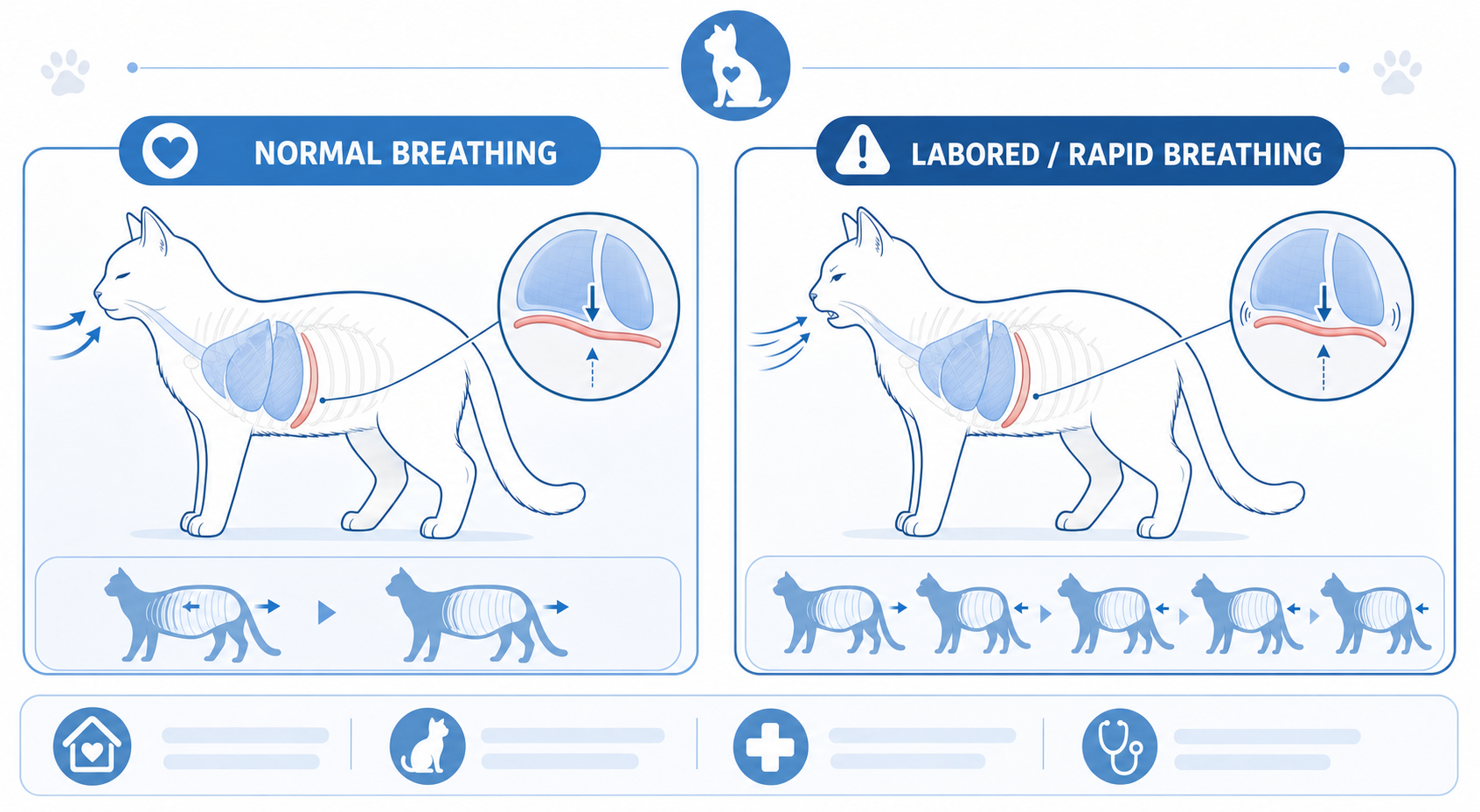
| What you notice | How to respond |
|---|---|
| Open-mouth breathing, blue/gray/pale gums, collapse, or severe belly effort | Emergency care now. Keep handling minimal and transport safely. |
| Fast breathing at rest that persists, repeated episodes, or increased effort | Call a veterinarian promptly for same-day guidance. |
| Briefly fast breathing after play that returns to normal when calm | Monitor closely; arrange care if it recurs or other signs appear. |
How to count a cat’s resting breathing rate
Wait until your cat is asleep or quietly resting and is not purring. Watch the chest or flank: one rise and fall equals one breath. Count for 30 seconds and multiply by two, or count for a full minute if the pattern is irregular. Write down the rate, time, and anything else you noticed. Do not delay emergency care while trying to obtain a perfect count.
Published veterinary reference tables commonly describe a resting cat rate around 16 to 40 breaths per minute, but an individual cat’s normal baseline matters. A persistent increase above that cat’s usual rate, especially with effort or other illness, deserves veterinary advice. A single number cannot rule in or rule out serious disease.
Do not use a home breathing count as a clearance test. A cat can appear quiet while still having dangerous breathing difficulty. If the rate is rising or the effort looks abnormal, contact a veterinary hospital.
Emergency signs: when fast breathing means go now
Seek emergency veterinary care immediately for any of these signs:
- Breathing with the mouth open or panting at rest.
- Strong abdominal movement, neck stretched forward, elbows held away from the body, or inability to settle.
- Blue, gray, white, or unusually pale gums; collapse; profound weakness; or confusion.
- Repeated coughing or gagging with distress, severe wheezing, or sudden worsening.
- A cat that cannot lie down comfortably, keeps changing position, or stops responding normally.
Keep the cat as calm and cool as practical. Use a carrier with good airflow, avoid forcing food or water, and do not give human medication. Call the receiving emergency hospital while you are leaving so the team can prepare.
Why might a cat breathe fast at rest?
Rapid breathing is a sign, not a diagnosis. Possible causes include:
- Heart disease or fluid related to heart failure: Cats may show faster resting breaths, reduced activity, hiding, weakness, or decreased appetite. Some cats do not cough.
- Asthma or other airway disease: Wheezing, coughing, crouching, or increased effort may occur. A flare can become dangerous quickly.
- Fluid, air, or inflammation around the lungs: These problems restrict expansion of the lungs and often cause shallow, effortful breathing.
- Infection or pneumonia: Fever, lethargy, nasal discharge, poor appetite, and faster breathing may occur together.
- Pain, overheating, anemia, or metabolic illness: These can increase breathing rate even when the lungs are not the primary problem.
- Stress or recent activity: The rate should improve as the cat relaxes. Persistent or recurrent fast breathing needs a veterinary assessment.
Because these conditions can look similar at home, a veterinarian may need an examination, oxygen assessment, blood work, chest imaging, or an ultrasound. Do not assume that a cat is “just anxious” if the breathing remains abnormal.
A simple observation flow
- Look: Is the mouth closed? Is the chest moving smoothly, or is the abdomen working hard?
- Count: Measure the resting rate once the cat is calm, without delaying care for red flags.
- Check context: Note recent exertion, heat, stress, possible toxin exposure, trauma, and any chronic heart or lung history.
- Act: Emergency signs mean go now; persistent fast breathing without those signs still warrants prompt veterinary contact.
What information should you bring to the veterinarian?
Record a short video from a distance if doing so does not delay care. Note the resting rate, whether your cat was asleep, appetite and water intake, coughing or sneezing, gum color, activity, medications, and when the change began. Tell the veterinarian about possible access to plants, chemicals, medications, or other toxins. Never give an over-the-counter human drug unless a veterinarian specifically prescribed it for that cat.
Frequently asked questions
Is it normal for a cat to breathe fast after playing?
Short-lived faster breathing can follow intense activity or stress, but it should settle as the cat relaxes. If it does not, keeps recurring, or looks effortful, call a veterinarian.
Is open-mouth breathing ever normal in a cat?
Occasional brief panting after extreme exertion can occur, but open-mouth breathing at rest or with distress is not something to watch at home. Treat it as an emergency.
Can purring make the breathing count inaccurate?
Yes. Wait for quiet sleep or rest and count chest rises rather than trying to count during purring.
My cat is breathing fast but still eating. Is that reassuring?
Normal appetite does not rule out an early or serious breathing problem. The breathing pattern and effort should determine how quickly you call.
Should I give my cat a human pain reliever?
No. Human pain relievers can be dangerous to cats. Contact a veterinarian for safe, species-appropriate treatment.
Related guides
For related owner education, see hypertrophic cardiomyopathy in cats, how to recognize pain in a cat, and when a cat not eating needs urgent care.
Comments
One response
[…] urethra usually just passes through in a female. If a female cat is straining with little or no urine coming out, she still needs to be seen right away — the underlying bladder disease can be just as painful […]