If your cat is straining in the litter box and producing little or no urine, treat it as an emergency right now — do not wait to see if it resolves. A blocked urinary tract, most common in male cats, can turn fatal within a day or two if the obstruction isn’t relieved.
This is one of the true emergencies in general practice. I’ve had owners call describing what they thought was constipation, only to find on exam that the bladder was rock-hard and the cat was already in trouble. Recognizing the difference between “my cat is straining to pee” and “my cat cannot pee at all” is a skill every cat owner should have, because it can mean the difference between a same-day fix and a life-threatening crisis.
This article covers what causes a urinary blockage, which cats are at highest risk, the exact signs that separate an emergency from ordinary straining, what happens at the emergency vet, and how to lower the odds of it happening again.
What a Urinary Blockage Actually Is
A urinary blockage, or urethral obstruction, happens when the tube that carries urine from the bladder out of the body becomes plugged. In most male cats the cause is a combination of crystals and mucus called a urethral plug, sometimes combined with small bladder stones. Severe bladder inflammation is thought to drive much of this, though in up to half of cases no single definitive cause is ever found — inflammation itself, independent of stones or infection, seems to be enough to trigger it.
Once the urethra is plugged, urine keeps being produced by the kidneys but has nowhere to go. The bladder distends like an overfilled balloon, pressure backs up toward the kidneys, and toxins that would normally leave the body in urine start to build up in the bloodstream instead.
Why Male Cats Are at Much Higher Risk
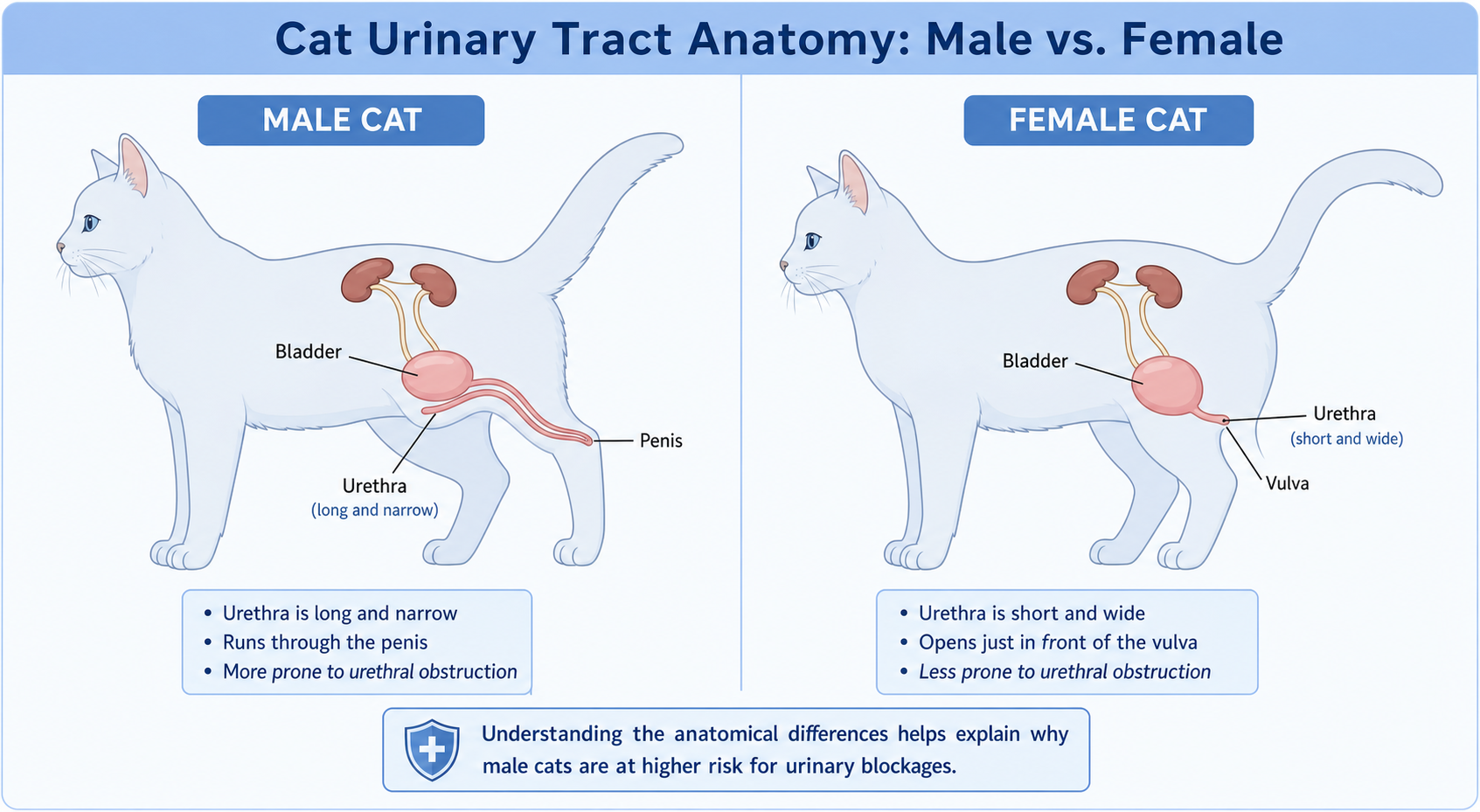
A male cat’s urethra is far narrower and longer than a female cat’s, which is why urinary blockage is overwhelmingly a male-cat problem — a female cat can develop the same underlying bladder inflammation and still pass a plug or small crystals without ever fully blocking. Any breed can be affected, but the highest-risk cat is typically:
- Male, and usually young to middle-aged (most affected cats are between 1 and 10 years old, with many cases in cats 1–5 years old)
- Overweight
- Fed an exclusively dry-food diet with limited water intake
- Living indoors only, in a multi-cat household, or under ongoing stress
- Prone to anxious, fearful, or easily stressed behavior
Blockages are also reported more often in the winter months. None of these factors guarantee a problem, and none rule one out — a slim, calm, wet-food-only cat can still block. They simply tell you who to watch more closely.
Early Signs vs. a Full Blockage: The Comparison That Matters
Early bladder inflammation and a complete blockage can look similar at first glance — that’s exactly why so many blocked cats get mistaken for “just a bit constipated.” The table below is the fastest way to tell them apart.
| Sign | Early / partial irritation | Complete blockage — true emergency |
|---|---|---|
| Litter box trips | More frequent, small amounts | Frequent attempts, nothing or a few drops come out |
| Urine appearance | May be blood-tinged | Little to no urine to see at all |
| Behavior in the box | Straining, some discomfort | Crying out, repeated unproductive straining, hiding |
| Belly / bladder | Soft, may be hard to even feel | Firm, swollen, painful — feels hard “like a baseball” |
| Energy and appetite | Usually normal | Lethargy, not eating, vomiting, weakness |
| Timeline to act | Vet visit same day to next day | Emergency vet immediately — do not wait |
If you are not certain whether your cat is producing any urine at all, treat it as a complete blockage and go to a veterinarian immediately. Guessing wrong in the “wait and see” direction is the mistake that costs cats their lives.
Why This Is a True Emergency, Not Something to Watch Overnight
A completely blocked cat cannot clear the metabolic waste products that the kidneys normally filter into urine. Those toxins build up in the bloodstream, and so does potassium — an electrolyte the heart is extremely sensitive to. Reported timelines vary by source, but the pattern is consistent: cats have gone into life-threatening electrolyte crisis and kidney injury in as little as 24 hours of complete obstruction, with uremia and death reported as early as 2–3 days if the blockage is never relieved.
Dangerously high potassium can throw off the heart’s rhythm well before a cat looks obviously “sick.” That’s part of why a cat that was straining yesterday and seems quiet and withdrawn today needs to be seen now, not after you watch for another day. There’s no home remedy or over-the-counter product that relieves a urethral blockage — this requires a veterinarian.
What Happens at the Emergency Vet
Every blocked cat gets checked for the two things that determine how urgent the first steps are: how sick the electrolytes and kidneys already are, and how firm and painful the bladder feels on exam.
- Bloodwork and an ECG. This checks potassium, kidney values, and heart rhythm before anesthesia — a cat with dangerously high potassium is stabilized with medication before anything else happens.
- Sedation or anesthesia to place a urinary catheter. The catheter clears the plug or stone and lets the bladder drain and get flushed. Most cats are successfully unblocked this way.
- Hospitalization with the catheter left in place, typically for a few days (commonly cited as around three to five days), along with IV fluids and pain control while the urethral swelling goes down and kidney values normalize.
- Monitoring after catheter removal to confirm the cat is urinating well on its own — cats are typically watched for roughly another 12–24 hours before discharge.
- Discharge medications, often including pain relief, medication to help the urethra relax, and sometimes a prescription urinary diet.
If a cat has bladder stones, or has blocked more than once or twice already, surgery may be discussed — either removing the stones directly or a procedure called a perineal urethrostomy, which widens the urethral opening to reduce the chance of blocking again. Reported costs for treating a blocked cat vary widely depending on severity and location, generally landing somewhere between a few hundred and a few thousand dollars — it’s worth asking your emergency clinic for an estimate range up front so there are no surprises mid-treatment.
Reducing the Risk of a Repeat Blockage
A cat that has blocked once is more likely to block again, but the practical changes below are the ones most consistently recommended after treatment:
- Add wet food or transition toward a canned diet, since dry-food-only cats show up more often in blockage cases
- Encourage water intake with fountains and multiple water bowls placed away from the litter box
- Provide multiple litter boxes, kept clean, in different locations of the home
- Reduce household stress where possible — more resting spots, vertical space, and predictable routines all help anxious cats
- Keep your cat at a healthy weight
- Follow any prescription urinary diet exactly as directed — it’s usually chosen specifically to reduce crystal formation and change urine pH
None of these guarantee it won’t happen again, but together they meaningfully lower the odds — and knowing the early warning signs means you’ll catch the next one faster if it does happen.
Frequently Asked Questions
Can a female cat get a urinary blockage?
It’s rare, but possible. A female cat’s urethra is much wider and shorter, so the same bladder inflammation that plugs a male cat’s urethra usually just passes through in a female. If a female cat is straining with little or no urine coming out, she still needs to be seen right away — the underlying bladder disease can be just as painful even without a full blockage.
How can I tell if my cat is peeing at all?
Check the litter for clumps or wet spots, and watch your cat directly if you can. A cat repeatedly entering and leaving the box, crying, or straining with no visible result should be assumed blocked until a vet says otherwise. When in doubt, don’t wait for confirmation — go in.
Is this the same thing as a urinary tract infection?
Not usually. Bacterial urinary infections are actually uncommon in cats. Most urinary blockages come from a combination of bladder inflammation, crystals, and mucus rather than a bacterial infection, though your vet will still check for one since it can occur alongside other causes.
Can I try to relieve the blockage at home?
No. There is no safe way to relieve a urethral blockage outside of a veterinary clinic. Attempting to express the bladder yourself risks rupturing it. This always requires sedation, a catheter, and monitoring by a veterinary team.
How much does it cost to treat a blocked cat?
It varies widely by clinic, region, and severity, generally ranging from a few hundred dollars for a straightforward, quickly caught case up to several thousand for a complicated one requiring extended hospitalization or surgery. Ask your emergency clinic for an estimate as soon as your cat is stable enough for you to have that conversation.
Will my cat block again after treatment?
It’s possible, especially in the first year after an episode. Diet changes, more water intake, and stress reduction lower the risk. Cats with two or more episodes are often candidates for a discussion about surgery to widen the urethra permanently.
My cat seems to be straining but it’s only been an hour — can I wait until morning?
If there’s any chance your cat has not produced urine in that time, no. The safest approach is always to have a veterinarian confirm your cat is not blocked rather than assume it will resolve overnight, because the difference between “safe to monitor” and “in crisis” can be a matter of hours.
Veterinary Sources & References:
Merck Veterinary Manual — Urethral Obstruction in Small Animals
American College of Veterinary Surgeons — Urinary Obstruction in Male Cats
University of Illinois College of Veterinary Medicine — Blocked Cats: An Emergency for Male Cats
PetMD — Urinary Tract Blockage in Cats
Leave a Reply