

If your dog is scratching, chewing at the paws, rubbing its face on the carpet, or dealing with repeat ear infections, skin allergies are one of the most common explanations — and one of the most common reasons dogs visit a veterinarian at all. The medical term for the most frequent underlying cause, environmental allergy, is atopic dermatitis.
The good news: skin allergies are rarely dangerous on their own, and most dogs can be managed comfortably once the trigger — or triggers, since many allergic dogs have more than one — is identified. The frustrating news: there’s no single blood test that says “yes, this is atopic dermatitis.” Getting to an accurate diagnosis takes a process of ruling things out, which is exactly what this guide walks through.
What Are Dog Skin Allergies?
A skin allergy happens when a dog’s immune system overreacts to something that shouldn’t normally cause a problem — pollen, dust mites, mold spores, flea saliva, or a food ingredient. That overreaction triggers inflammation, which shows up as itching, redness, and irritated skin.
There are three main categories:
- Flea allergy dermatitis — a hypersensitivity to proteins in flea saliva. A single bite can trigger days of intense itching, even if you never see a flea on the dog.
- Food allergy — an immune reaction to a specific protein in the diet, most often beef, chicken, egg, dairy, wheat, or soy.
- Atopic dermatitis (environmental allergy) — a chronic, often lifelong sensitivity to airborne or contact allergens like pollen, mold, and dust mites.
Many allergic dogs deal with more than one of these at once, which is part of why diagnosis takes some patience.
Atopic dermatitis specifically is now understood as more than a simple allergic reaction. Current veterinary consensus describes it as a condition involving three things working together: a genetic predisposition, a skin barrier that doesn’t hold moisture and keep allergens out as effectively as it should, and an immune system that overreacts to allergens that cross that weakened barrier. That’s a meaningful shift from thinking of it as “just an allergy” — it explains why atopic dogs often have chronically sensitive skin even between flare-ups.
What Does an Allergic Dog Look Like?
Itching (pruritus) is the hallmark sign, but it shows up in different ways:
- Scratching, especially behind the elbows and along the sides
- Licking or chewing at the paws
- Rubbing the face and eyes on furniture or carpet
- Recurrent or long-standing ear infections — sometimes the only visible sign
- Hair loss, redness, or brown salivary staining on light-colored fur from constant licking
- Thickened, darkened (“elephant skin”) patches in chronically affected areas
- Scooting or licking around the base of the tail
The areas most commonly affected are the paws, face, ears, armpits (axillae), and abdomen — a distribution pattern seen consistently across veterinary references. Flea allergy dermatitis tends to show up differently: more toward the lower back, tail base, and inner thighs.
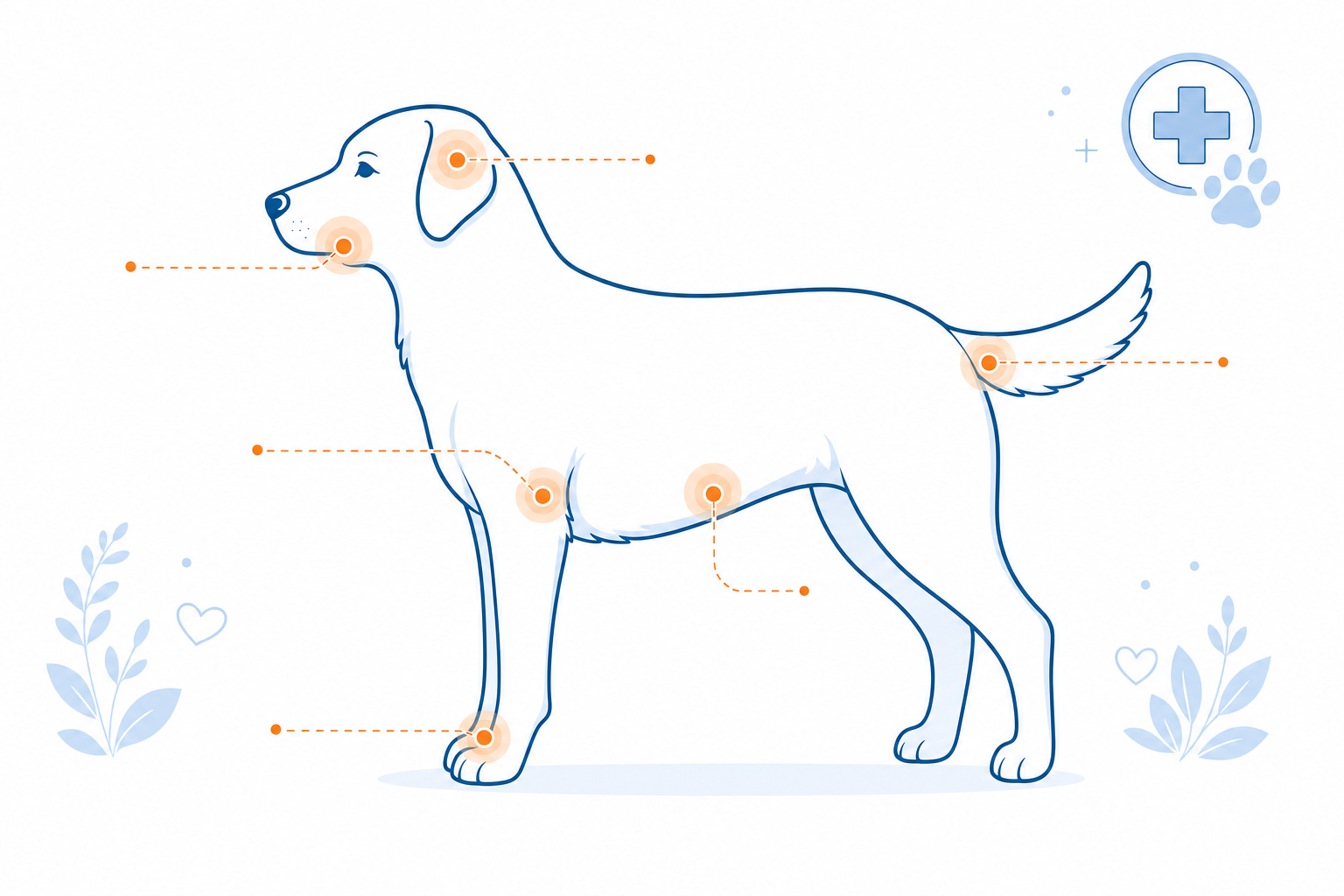
Atopic dermatitis typically starts young, between 6 months and 3 years of age, and about 40–75% of affected dogs have a seasonal pattern at first — often worsening in spring and fall — before it can progress to a year-round problem for some dogs. In warm, humid regions like Central Florida, that “seasonal” pattern is less clear-cut: fleas and many environmental allergens are present nearly year-round, so flare-ups can look constant rather than tied to a specific season.
Certain breeds are more commonly affected, including Golden Retrievers, Labrador Retrievers, West Highland White Terriers, Shih Tzus, Boxers, Boston Terriers, French and English Bulldogs, and Chinese Shar-Peis — though any dog, including mixed breeds, can develop allergic skin disease.
What Causes Dog Skin Allergies?
Fleas
Flea allergy dermatitis doesn’t require an infestation — a hypersensitive dog can react intensely to a single bite. In warm climates like Florida, flea populations can persist all year rather than dying back in winter, which means flea-related itching can’t be ruled out just because “it’s not flea season.” Consistent, year-round flea prevention is one of the simplest and most effective things an owner can do, both for treatment and for ruling fleas out diagnostically.
Food
True food allergies are less common than environmental allergies, but they cause the same kind of itching, redness, and skin irritation — often without much seasonal pattern. The most frequent trigger proteins are beef, chicken, egg, dairy, wheat, and soy. Food allergies can develop at any point in a dog’s life, even after months or years of eating the same diet without issue.
Environmental allergens (atopic dermatitis)
Pollen, grasses, mold spores, dust mites, and dander are the classic atopic triggers. These allergens contact the skin directly or are inhaled, and in a genetically predisposed dog with a compromised skin barrier, they set off the itch-inflammation cycle described above.
Secondary infections that make everything worse
Once a dog is chronically itchy, the skin barrier breaks down further, allowing yeast (Malassezia) and bacteria (usually Staphylococcus) to overgrow. These secondary infections are extremely common in allergic dogs and often account for the smell, greasy or crusty skin, and sudden worsening that brings owners in for an urgent visit. Treating the underlying allergy without addressing a secondary infection rarely gives lasting relief — both need attention.
How Vets Diagnose Skin Allergies
This is the part that surprises a lot of owners: there is no single blood or skin test that diagnoses atopic dermatitis. Allergy testing (intradermal skin testing or blood/serum IgE testing) doesn’t confirm the diagnosis — its real purpose is identifying specific allergens once atopic dermatitis is already suspected, mainly to guide allergen-specific immunotherapy (allergy shots or drops). Atopic dermatitis is what’s known as a diagnosis of exclusion: it’s confirmed by ruling out the other possibilities first, not by a positive test result.
A thorough diagnostic workup generally includes:
- A detailed history — when itching started, whether it’s seasonal or constant, flea prevention history, diet history, and how the dog has responded to past treatments.
- A full physical exam, checking the classic sites: ears, paws, face, armpits, and abdomen.
- A minimum dermatologic database — skin cytology (checking for yeast and bacteria under the microscope), skin scrapings (ruling out mites like sarcoptic mange or demodex), flea combing, and ear cytology if there’s ear involvement.
- Ruling out fleas and parasites first, since this is the most treatable cause and must be excluded before moving forward. A flea-control trial with a fast-acting, vet-recommended product is often used as both treatment and a diagnostic step.
- An elimination diet trial, if food allergy hasn’t been ruled out. This is the only reliable way to diagnose a food allergy — there is no accurate blood or saliva test for it, despite what some at-home kits claim.
- Only then, allergy testing (if immunotherapy is being considered) to identify which specific environmental allergens to target.
What an elimination diet trial actually looks like
This step trips up more owners than any other part of the process, mostly because it sounds simple and isn’t quite as simple in practice:
- The dog eats only a novel-protein or hydrolyzed-protein prescription diet — no ingredient the dog has ever eaten before.
- Everything counts: treats, table scraps, flavored medications and supplements, and even flavored toothpaste can restart the reaction and invalidate the trial.
- The trial needs to run for a meaningful stretch of time — commonly 8 weeks, sometimes up to 12, before concluding food isn’t the cause. Stopping after two weeks because “it doesn’t seem to be working” is one of the most common reasons food allergy trials fail to give a clear answer.
- If symptoms improve, the original diet is reintroduced to confirm the diagnosis — a relapse of itching (often within hours to two weeks) confirms food was involved.
- Individual ingredients can then be added back one at a time to identify the specific culprit, if that level of detail is useful for long-term feeding.
Treatment: What Actually Helps
Atopic dermatitis can’t be cured, but it can almost always be well managed. Because every allergic dog is different, treatment plans are typically multimodal — combining several approaches rather than relying on one medication.
Addressing flare-ups
- Bathing with a vet-recommended shampoo, done weekly to biweekly, physically removes allergens from the coat and skin and is one of the most effective, lowest-risk parts of an allergy plan.
- Short-term topical or oral anti-inflammatory medication for acute flares.
- Treating any secondary yeast or bacterial infection identified on cytology — this step is often what makes a “stubborn” case finally turn a corner.
Long-term management options
- Oral medications such as oclacitinib or ilunocitinib (JAK inhibitors) and lokivetmab (an injectable that targets the itch signal directly) are commonly used for long-term itch control, each with its own onset time, dosing schedule, and monitoring needs set by a veterinarian.
- Cyclosporine, another long-term option, typically takes 4–6 weeks to show full benefit and isn’t used for sudden flares.
- Antihistamines work best as a preventive, ongoing part of a combination plan rather than as rescue treatment once a flare is already severe.
- Essential fatty acid supplements (fish oil with EPA/DHA) support skin barrier health as an add-on therapy, though they take weeks to have an effect and aren’t a stand-alone fix.
- Allergen-specific immunotherapy (“allergy shots” or oral drops), based on allergy testing, is the only approach that can meaningfully change the immune response over time rather than just controlling symptoms. It requires real commitment — most dogs need close to a year of treatment before an owner and veterinarian can judge whether it’s working — but it has a good track record for dogs who complete a full course.
Ongoing flea and parasite prevention
Because fleas can trigger or worsen atopic flare-ups even in a dog that isn’t primarily flea-allergic, year-round flea prevention is part of essentially every long-term allergy management plan — not an optional extra, especially in warm climates where fleas don’t reliably die off in cooler months.
When to Call Your Veterinarian
Call your veterinarian now (same day or as an urgent visit) if your dog has:
- Sudden, severe swelling of the face, muzzle, or throat, or difficulty breathing (possible acute allergic reaction — this is an emergency)
- Open sores, significant hair loss, or a strong odor from the skin (likely secondary infection needing treatment)
- Itching so intense it’s disrupting sleep, causing self-trauma, or bleeding
- Sudden worsening after starting a new medication, food, or topical product
Schedule a routine or soon appointment if your dog has:
- Itching, redness, or paw licking lasting more than a couple of weeks
- Recurring ear infections, even if they clear up with treatment each time
- Itching that seems to follow a seasonal pattern year after year
- Skin or coat changes — darkening, thickening, greasy texture, or persistent odor — without obvious sores
Living With a Dog That Has Skin Allergies
Atopic dermatitis is typically a lifelong condition, but “lifelong” doesn’t mean unmanageable. Most allergic dogs do well long-term with a consistent plan: regular flea prevention, an appropriate bathing routine, prompt attention to secondary infections, and whichever combination of long-term medication or immunotherapy works for that individual dog. Expect the plan to be adjusted over time — what controls symptoms in year one may need tweaking as the dog ages or as new triggers appear — and keep in touch with your veterinarian rather than troubleshooting alone when something changes.
If your dog’s itching has been written off as “just a phase” or treated repeatedly with the same short-term fix without real improvement, a full diagnostic workup — not just another round of medication — is usually the more effective next step. For dogs with a lot of visible bumps, lumps, or growths rather than generalized itching and redness, it’s also worth ruling out that those aren’t a separate skin issue entirely; see our visual guide to bumps on dogs’ skin for how allergic skin changes differ from discrete growths.
If paw licking and chewing are the main complaint, our complete guide to itchy feet in dogs covers that specific presentation in more detail, and our general dog itching guide covers broader at-home relief steps for day-to-day scratching.
Frequently Asked Questions
Can dog skin allergies go away on their own?
Flea allergy symptoms improve once fleas are eliminated, and a true food allergy resolves with strict avoidance of the trigger ingredient. Atopic dermatitis (environmental allergy), however, is typically a lifelong condition that’s managed rather than cured — though many dogs do very well long-term with a consistent plan.
How can I tell if it’s fleas, food, or environmental allergies?
This is genuinely hard to tell from symptoms alone, since all three cause similar itching and skin changes. That’s exactly why the diagnostic process rules out fleas first, then food through an elimination diet trial, before concluding it’s environmental (atopic dermatitis).
Is allergy testing (blood or skin test) worth doing?
Allergy testing doesn’t diagnose atopic dermatitis — it identifies specific allergens once atopic dermatitis is already the working diagnosis, mainly to plan allergen-specific immunotherapy. Doing it earlier, hoping it will explain the itching, often leads to confusing or misleading results.
How long does an elimination diet trial take?
Typically 8 weeks, sometimes up to 12, feeding only the prescribed diet with zero exceptions — no treats, table food, or flavored medications from another source. Trials stopped too early are one of the most common reasons the results are unclear.
Are some dog breeds more prone to skin allergies?
Yes. Golden Retrievers, Labrador Retrievers, West Highland White Terriers, Shih Tzus, Boxers, Bulldogs, and Chinese Shar-Peis are frequently affected, though any breed — including mixed-breed dogs — can develop allergic skin disease.
Does living in Florida make dog allergies worse?
Warm, humid climates support flea populations and many environmental allergens nearly year-round, so the clean “seasonal allergy” pattern seen in colder regions is often less obvious here. Dogs may show near-constant low-level itching rather than clear seasonal flares, and flea prevention needs to be maintained all year, not just in summer.
What’s the difference between atopic dermatitis and a regular skin infection?
A skin infection (bacterial or yeast) can occur completely on its own, but it’s also one of the most common complications of allergic skin disease — chronically itchy, inflamed skin is much easier for bacteria and yeast to overgrow on. Many allergic dogs need both allergy management and infection treatment at the same time.
Can I manage my dog’s skin allergies with over-the-counter products alone?
Gentle vet-recommended shampoos and fatty acid supplements can genuinely help as part of a plan, but they rarely control moderate-to-severe atopic dermatitis on their own, and relying only on over-the-counter options can delay diagnosing an underlying infection or a treatable cause like fleas or food. A veterinary exam is the right starting point before building a home-care routine.
Will my dog need medication for the rest of its life?
Not necessarily continuous medication — some dogs do well with seasonal treatment, allergen-specific immunotherapy that reduces or eliminates the need for daily medication over time, or a maintenance routine of bathing and flea prevention alone. It depends on severity and how the individual dog responds.
Veterinary Sources & References
- American Animal Hospital Association. 2023 AAHA Management of Allergic Skin Diseases in Dogs and Cats Guidelines.
- Merck Veterinary Manual. Atopic Dermatitis in Dogs.
- Merck Veterinary Manual. Allergies in Dogs (Dog Owners).
- Merck Veterinary Manual. Flea Allergy Dermatitis in Dogs and Cats.
- Cornell University College of Veterinary Medicine, Riney Canine Health Center. Atopic Dermatitis (Atopy).
Leave a Reply