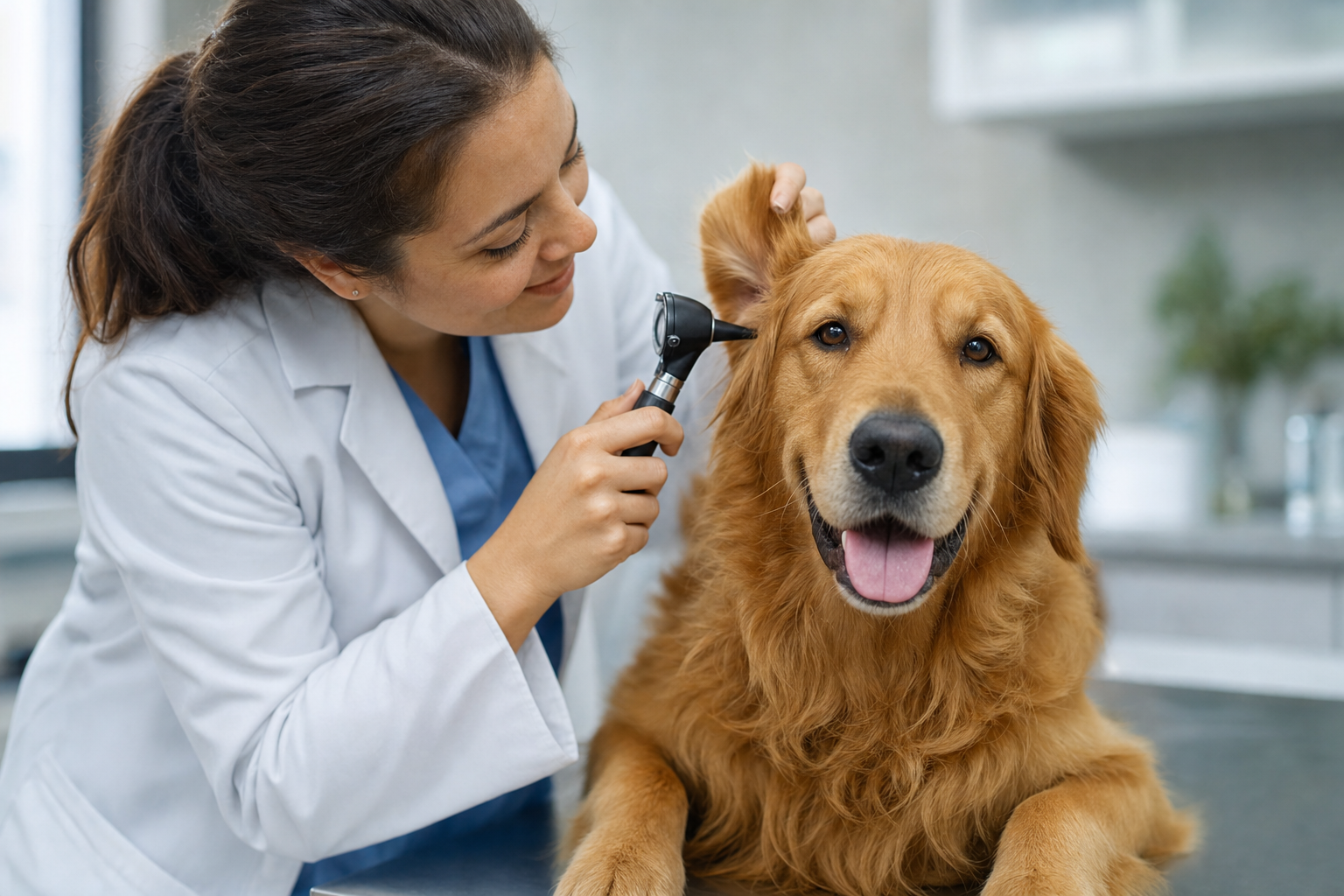
If your dog is shaking its head, scratching at one ear, or you’ve noticed a yeasty or foul smell coming from inside the ear, the most likely explanation is otitis externa — an infection or inflammation of the outer ear canal. It’s one of the most common reasons dogs are brought in for a veterinary visit, and in most cases it’s very treatable once the cause is identified.
This article is specifically about outer ear infections — the everyday kind that cause itching, odor, and discharge but usually don’t affect balance or hearing beyond some temporary muffling. That’s different from a middle ear infection (otitis media) or vestibular disease, which are less common and involve deeper structures behind the eardrum — those can cause a head tilt, loss of balance, stumbling, or facial drooping. If your dog is showing those signs, read Otitis Media & Vestibular Syndrome in Dogs and Cats instead, since that’s a different condition with a different urgency level. Chronic, untreated outer ear infections can eventually progress into a middle ear infection, which is one reason recurring ear problems shouldn’t be ignored — but the two are not the same diagnosis.
What Is Otitis Externa?
Otitis externa is inflammation of the ear canal — the tube-shaped passage that runs from the visible ear opening down to the eardrum. It’s one of the most common problems seen in general dog practice. The canal’s skin normally hosts small numbers of harmless bacteria and yeast, but when something disrupts that balance — allergies, moisture, a foreign object, or a change in the canal’s normal environment — those organisms multiply and cause inflammation, irritation, and infection.
Otitis externa can affect one ear or both, and it can be a one-time issue or a recurring problem, depending on what’s driving it.
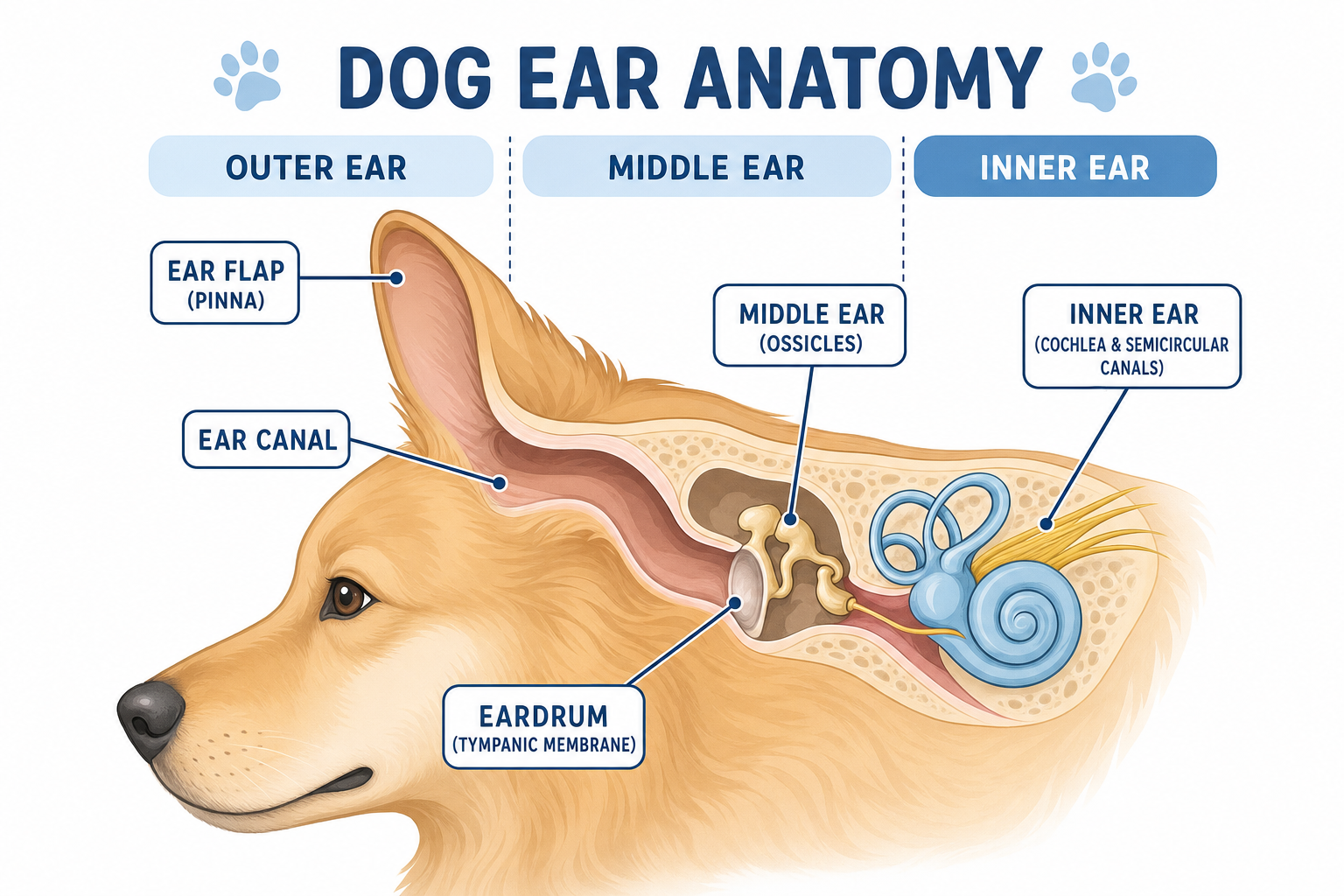
Signs Your Dog May Have an Ear Infection
Ear infections don’t always look the same in every dog, but a few signs show up consistently:
- Head shaking or tilting — an occasional shake is normal; frequent, repeated shaking is not.
- Scratching or rubbing the ear — against furniture, carpet, or with a paw.
- Odor — a yeasty or foul smell coming from the ear canal is one of the most reliable red flags.
- Discharge — brown, yellow, or bloody debris inside the ear or on the fur below it.
- Redness or swelling — visible inside the ear flap or at the canal opening.
- Pain or sensitivity — flinching, pulling away, or reluctance to let the ear be touched.
- Scabbing or crusting — especially at the edges of the ear canal from repeated scratching.
Mild cases sometimes look like nothing more than a dog rubbing its ear on the couch once in a while. It’s when that behavior becomes frequent, or is joined by odor or discharge, that it’s worth taking seriously.
A note on what this is not: loss of balance, circling, stumbling, a head tilt that doesn’t go away, or facial drooping are not typical outer-ear symptoms. Those point toward middle or inner ear involvement and deserve prompt veterinary evaluation — see the section on when to call the vet below.
Why Do Dogs Get Ear Infections? (Causes)
Ear infections almost never happen for no reason. According to the Merck Veterinary Manual, causes generally break down into two groups: things that start the problem, and things that let it keep happening.
Primary causes disrupt a normal, healthy ear canal:
- Allergies — environmental (pollen, dust, mold) or food-related allergies are, by far, the most common underlying driver of recurring ear infections in dogs.
- Ear mites and other parasites — more common in puppies, but possible at any age.
- Foreign material — grass seeds, foxtails, or debris that work their way into the canal.
- Hormonal disease — conditions like hypothyroidism can change skin and ear health.
- Moisture — water trapped in the ear after swimming or bathing creates a favorable environment for bacteria and yeast.
Secondary causes are the actual infections that take hold once the environment in the canal has already been disrupted — most often bacterial overgrowth or yeast (Malassezia) overgrowth, sometimes both at once.
Anatomy plays a role too. Dogs with floppy, pendulous ears (Cocker Spaniels, Basset Hounds, Labrador Retrievers, and similar breeds) or narrow, hairy ear canals trap heat and moisture more easily, which raises the baseline risk even without an obvious trigger.
Why Ear Infections Keep Coming Back
This is the part that frustrates a lot of owners, and it’s worth being direct about: if an ear infection resolves with treatment and then comes back a few weeks or months later, treating the infection itself was never going to be a permanent fix. The infection is usually a symptom of something else — most often an underlying allergy — and until that root cause is identified and managed, the ear will keep re-infecting.
This is one of the most consistent patterns seen in general practice. A dog gets ear drops, the ear looks and smells normal within a week or two, and everyone moves on — until it flares up again in a few months, often around the same time of year if the trigger is seasonal environmental allergies. Dogs with genuinely recurrent ear infections are worth discussing allergy testing or a hypoallergenic diet trial with a veterinarian, rather than treating each flare-up as an isolated event.
How Ear Infections Are Diagnosed
An ear infection is usually confirmed with a combination of a physical exam, an otoscopic exam, and — especially for recurring or stubborn cases — cytology.
- History and physical exam. A veterinarian will ask about onset, prior episodes, allergy signs elsewhere on the skin, swimming or bathing habits, and any other symptoms.
- Otoscopic exam. A handheld or video otoscope lets the vet look down the canal to check for redness, swelling, discharge, foreign material, or a damaged eardrum. Painful ears sometimes need mild sedation for a thorough look.
- Cytology. A cotton swab sample from the ear canal, examined under a microscope, shows whether the problem is bacterial, yeast, mite-related, or mixed — this matters because it changes which medication is used.
- Additional testing when needed. For chronic, one-sided, or unusually stubborn cases, allergy testing, imaging of the middle ear, or a diet trial may be recommended to find the underlying trigger.
Cytology in particular is worth asking about if an ear infection isn’t behaving typically — treating a yeast infection like a bacterial one (or vice versa) is a common reason initial treatment doesn’t work.
Treatment: Topical vs. Oral Medication
Most outer ear infections are treated with topical ear medication — drops or ointment applied directly into the canal, usually combining an antibiotic, antifungal, and anti-inflammatory in one product. For a straightforward, first-time infection with an intact eardrum, topical treatment alone is often enough.
Oral or systemic medication becomes necessary when:
- The infection is severe, deeply established, or not responding to topical treatment alone.
- There’s significant swelling narrowing the canal, which prevents topical medication from reaching where it needs to go.
- The eardrum is ruptured or can’t be confirmed intact, which changes which topical products are safe to use.
- Middle ear involvement is suspected — this is one of the situations where oral or injectable medication is added.
- The infection is chronic or has already failed one course of appropriate topical treatment.
Cleaning is part of treatment, not just prevention — topical medication doesn’t work well through built-up wax and discharge, so the ear typically needs to be cleaned before medicating, and a vet visit that includes an in-clinic cleaning often meaningfully improves how well treatment works. Oral steroids or anti-inflammatories are sometimes used short-term to reduce pain and swelling enough for the owner to be able to clean and medicate the ear at home at all.
Do not use home remedies like vinegar or hydrogen peroxide mixtures in an actively inflamed or infected ear — according to the Merck Veterinary Manual, these can worsen swelling and secretions and increase the risk of further irritation, and they should be avoided unless specifically recommended by a veterinarian for a healthy ear.
Treatment typically continues until a recheck confirms the infection has fully cleared, not just until the ear looks or smells better — many dogs need 2 to 4 weeks of treatment, and chronic or severe cases can take considerably longer.
The Limits of At-Home Care
A lot of mild, early ear irritation can be managed with routine at-home care: regular ear checks, gentle veterinarian-approved cleaning, and keeping ears dry after swimming or baths. But at-home care has real limits, and it’s worth being upfront about them:
- At-home cleaning treats symptoms, not the underlying cause — it won’t fix an allergy-driven infection on its own.
- Over-the-counter ear products aren’t matched to what’s actually growing in the ear (bacteria vs. yeast vs. mites), so they can miss the target entirely.
- Cleaning a painful, already-inflamed ear can make a dog more resistant to future cleaning and treatment, and can worsen irritation if done incorrectly.
- Overcleaning healthy ears can strip protective oils and normal bacteria, which paradoxically increases infection risk.
If an ear infection hasn’t improved within 2 to 3 days of starting an appropriate treatment, or if it’s a recurring problem, at-home management on its own isn’t enough — it’s time for a veterinary exam.
When to Call Your Veterinarian
Schedule a routine visit within a few days if your dog has:
- Occasional head shaking or scratching at one ear
- Mild odor or a small amount of discharge
- No pain when the ear is gently touched
Seek prompt veterinary care (within 24–48 hours) if your dog has:
- Strong odor, heavy discharge, or visible swelling in the canal
- Obvious pain, pulling away, or aggression when the ear is touched
- An infection that hasn’t improved after 2–3 days of treatment
- Repeated ear infections in the past several months
Seek urgent or emergency care if your dog has:
- A head tilt, stumbling, circling, or loss of balance
- Facial drooping or asymmetry
- Sudden refusal to eat along with ear symptoms
These last signs suggest the problem may have moved beyond the outer ear — see Otitis Media & Vestibular Syndrome in Dogs and Cats for what those signs mean and how that condition is evaluated.
Outer Ear Infection vs. Middle Ear Infection: Quick Comparison
| Outer Ear Infection (Otitis Externa) | Middle Ear Infection (Otitis Media) | |
|---|---|---|
| What’s affected | Ear canal (visible, reachable with an otoscope) | Space behind the eardrum (not visible without imaging) |
| Typical signs | Head shaking, scratching, odor, discharge, redness | Head tilt, loss of balance, facial drooping, nystagmus |
| How common | Very common — one of the top reasons dogs see a vet | Less common — usually develops from untreated chronic otitis externa |
| Balance/hearing affected | Usually not, unless severe or chronic | Often, because of proximity to the vestibular system |
| Typical treatment | Topical ear medication ± cleaning; oral medication if severe | Often requires oral/systemic medication; sometimes imaging or surgery |
| Urgency | Routine to prompt, depending on severity | Prompt to urgent, especially with neurological signs |
Preventing Ear Infections
Prevention is most effective for dogs at elevated risk — floppy-eared breeds, frequent swimmers, and dogs with known allergies:
- Dry ears thoroughly after baths and swimming; avoid letting water sit in the canal.
- Clean ears only as often as recommended by a veterinarian — for most dogs this is not a daily task, and overcleaning can do more harm than good.
- Address allergies directly if a dog has recurring infections — this is the single highest-leverage step for breaking the cycle.
- Keep up with routine veterinary checkups, where early ear changes are often caught before they become a full infection — see Yearly Pet Physical Exams for what a routine exam covers.
- Watch for related skin signs. Dogs with chronic itching, especially around the feet and body, often have the same underlying allergy driving both the skin and the ears — see Dog Itching: Causes, Diagnosis, and Treatment and Dog Itchy Feet: Complete Guide if that sounds familiar.
For owners in Central Florida, humidity and swimming season make outer ear infections especially common in warmer months — it’s a frequent, very treatable complaint seen in general and relief veterinary practice across the region, including areas like Bushnell and the wider Pasco and Hernando County area.
Frequently Asked Questions
Can I treat my dog’s ear infection at home without seeing a vet?
Mild, early irritation sometimes responds to gentle cleaning and drying, but a true infection usually needs a specific diagnosis (bacterial, yeast, mites, or a combination) to choose the right medication. If there’s odor, discharge, pain, or the problem doesn’t clear up within a couple of days, it’s time for a veterinary exam rather than continued home treatment.
Why does my dog keep getting ear infections?
Recurring infections almost always point to an underlying trigger — most commonly an environmental or food allergy — rather than the ear itself being the root problem. Breaking the cycle usually means identifying and managing that underlying cause, not just treating each flare-up as it happens.
How long does it take for a dog’s ear infection to clear up?
Straightforward infections often improve within a few days of starting the right treatment, but most need continued treatment for 2 to 4 weeks to fully resolve, confirmed with a recheck exam. Chronic or severe cases can take considerably longer, and some dogs need long-term management rather than a one-time cure.
Are some dog breeds more prone to ear infections?
Yes. Breeds with floppy or pendulous ears (Cocker Spaniels, Basset Hounds, Labrador Retrievers) and breeds prone to allergies are at higher risk because of trapped moisture, reduced airflow, and a greater likelihood of the allergic triggers that drive infections in the first place.
Is a dog ear infection an emergency?
Most are not emergencies — they’re uncomfortable but treatable on a routine or prompt-care basis. It becomes urgent if a head tilt, loss of balance, facial drooping, or sudden refusal to eat appears alongside ear symptoms, since those signs suggest the infection may have reached the middle or inner ear.
Can ear infections cause hearing loss in dogs?
Chronic, poorly controlled infections can lead to changes in the ear canal over time and, in severe or long-standing cases, affect hearing. This is one more reason recurring infections are worth fully treating and following up on rather than managing symptom by symptom.
Is a dog ear infection the same as a human ear infection?
The basic idea — inflammation and infection of the ear canal — is similar, but the underlying triggers and treatment approach in dogs are shaped by their own ear anatomy and their frequent link to allergies, which makes veterinary evaluation and pet-specific medication necessary rather than substituting human ear products.
Veterinary Sources & References
- Merck Veterinary Manual — Ear Infections and Otitis Externa in Dogs
- Merck Veterinary Manual — Otitis Externa in Animals
- Merck Veterinary Manual — Otitis Media and Interna (Middle and Inner Ear Infections) in Dogs
- American Veterinary Medical Association / JAVMA — Managing recurrent otitis externa in dogs: what have we learned and what can we do better?
- PMC (National Library of Medicine) — Canine otitis externa — Treatment and complications
Leave a Reply