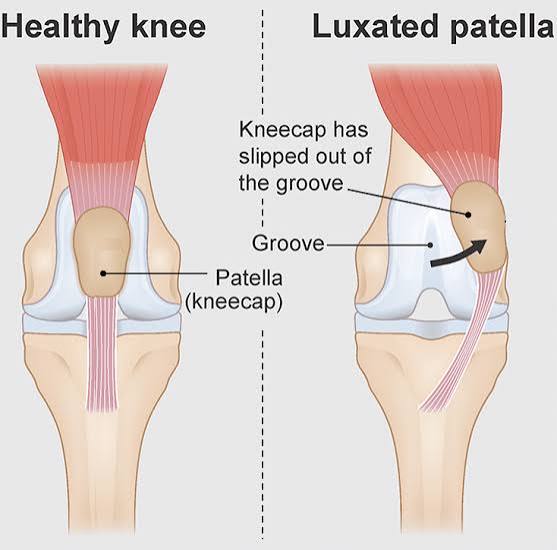
A dog that suddenly carries a back leg for a few steps, then walks normally again, may have a luxating patella—a kneecap that slips out of its normal track. That skip is a classic sign, but it isn’t a diagnosis on its own. A veterinary exam can determine whether the knee is unstable and rule out other orthopedic problems.
If a dog is suddenly unable to bear weight, is in severe pain, or was just injured, contact a veterinarian right away. For help recognizing urgent lameness signs, see My Dog Is Limping: When Should I See a Vet?
What is a luxating patella in dogs?
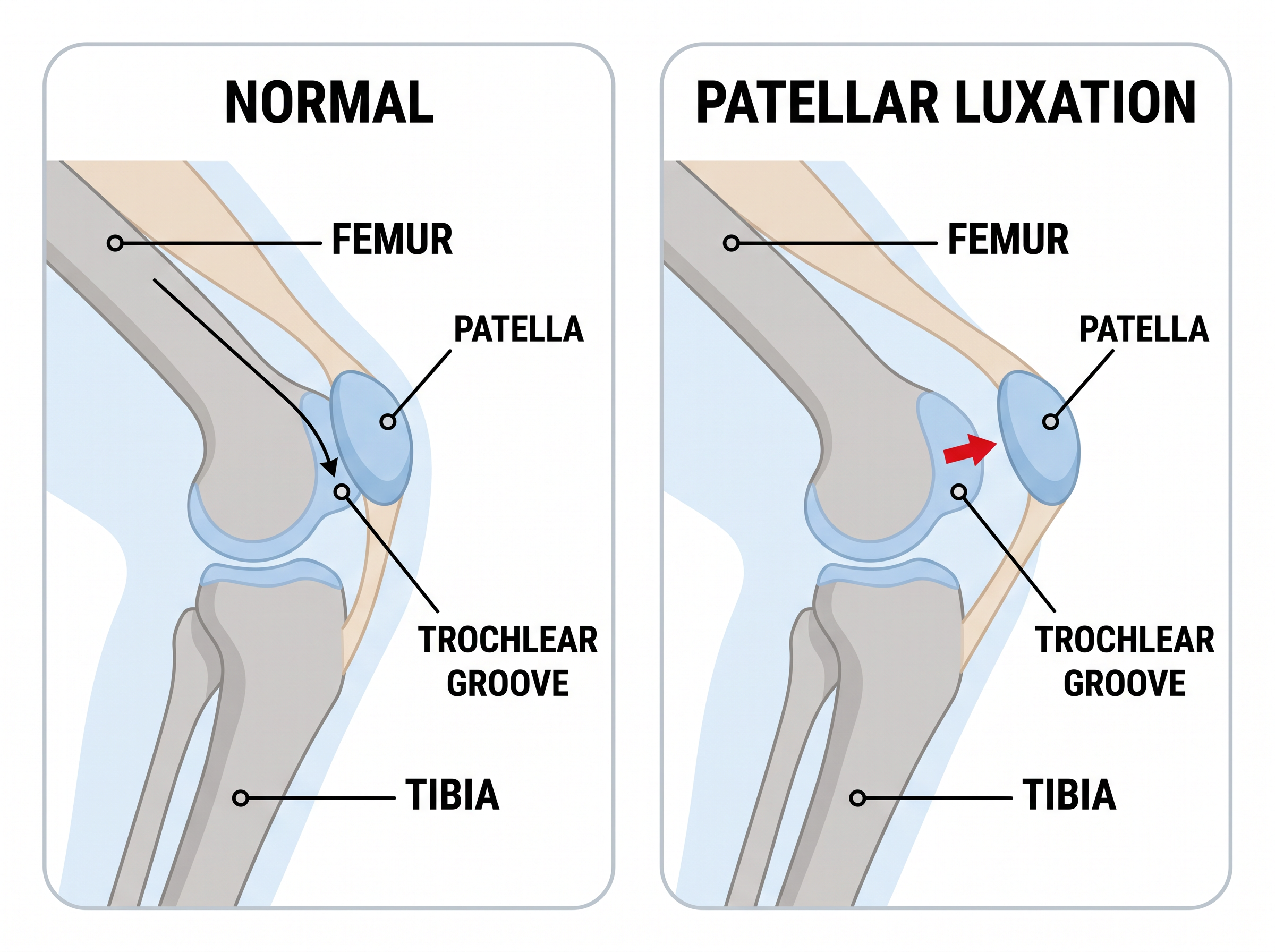
The patella is the kneecap. It normally glides within a groove at the end of the thigh bone as the knee bends and straightens. Patellar luxation means the kneecap moves out of that groove, either toward the inside of the leg (medial) or the outside (lateral). It’s usually a developmental issue related to how the structures around the knee formed and lined up, though trauma can cause a luxation too.
Understanding the luxating patella in dogs is crucial for owners to ensure their pets receive the appropriate care and treatment.
Medial luxation is more common and tends to show up in small and miniature breeds. Lateral luxation is less common and shows up more often in larger dogs. Either knee—or both—can be affected.
A dog’s anatomy, signs, age, activity level, and any limb deformity matter more than a breed label alone. The real question isn’t whether a dog fits a certain type—it’s whether the knee is stable and comfortable, and whether the problem is getting worse.
Signs to watch for
The most recognizable sign is intermittent hind-leg lameness: a dog briefly lifts a rear leg, takes a few skipping steps, kicks or shakes the leg, then walks normally again. Mild cases may show little or no outward sign. More advanced cases can cause more constant lameness, trouble straightening the knee, or a crouched or altered hind-leg stance.
An appointment is worth scheduling for recurring skipping, a limp that returns after activity, reluctance to use the rear leg, or any change in how a dog runs or gets up. A short video of the gait can help, since the kneecap may already be back in place by the time of the visit. Sudden yelping or limping can have many causes; Dog Yelping in Pain and Limping covers other warning signs that call for timely care.
What to note before the appointment
- A brief rear-leg skip that resolves after a few steps
- A limp that comes and goes
- The leg being lifted, kicked, or shaken
- A persistent limp or trouble straightening the knee
- Sudden severe pain or inability to bear weight after an injury—contact a veterinarian right away
These signs can have more than one cause. An exam is needed to diagnose a luxating patella.
Patellar luxation grades: 1 through 4
Veterinarians grade a luxation by how often the kneecap is out of place and whether it can be moved back into the groove. The grade describes what’s found on exam—it’s one part of a treatment decision, not a guarantee of a particular surgery or outcome.
| Grade | What the exam finds | What an owner may notice |
|---|---|---|
| 1 | The patella can be moved out of the groove during examination but returns to position on its own. | No signs, or mild and infrequent signs. |
| 2 | The patella may slip out on its own or with manipulation and can remain out temporarily; it can be returned manually or by extending the leg. | Intermittent skipping or weight-bearing lameness may occur. |
| 3 | The patella is out most of the time; it can be replaced manually but readily slips out again. | Lameness is more consistent, and bone changes may be present. |
| 4 | The patella is permanently out and cannot be replaced manually. | Severe lameness and limb deformity may be present. |
Grade is only one piece of the picture. Symptoms, limb alignment, age, activity level, and imaging findings all factor into the plan.
How a luxating patella is diagnosed
Diagnosis starts with a history, watching the gait, and a hands-on exam of the knee. During flexion and extension, the exam shows where the patella moves and how easily it can be displaced or put back in place. Both knees are checked.
X-rays may be recommended to evaluate the leg and look for other orthopedic issues. In more complex cases, or when surgery is being planned, advanced imaging may be recommended.
This evaluation also helps rule out related knee problems—cranial cruciate ligament tears and meniscal injuries should be identified and treated if present.
When conservative management may fit
Conservative care doesn’t correct the underlying anatomy. Its purpose is to support comfort and function when signs are mild, when a dog isn’t a good surgical candidate, or while the condition is being monitored. It’s generally reserved for dogs with mild signs—Grade 1 and some Grade 2 cases with little or no lameness—as well as older dogs or dogs for whom surgery isn’t feasible.
A veterinarian-directed conservative plan may include:
- keeping the dog at a healthy body weight
- controlled, low-impact activity and activity adjustments
- physical rehabilitation when recommended
- pain relief or anti-inflammatory treatment prescribed for that individual dog
These measures can improve comfort, but the patella can still progress because the anatomical cause is still there.
A human pain medicine or another pet’s leftover prescription should never be given. Safe options should always come from a veterinarian; What Can I Give My Dog for Pain Relief? covers this in more depth. If a dog has already swallowed medication that wasn’t prescribed for it, see the urgent guidance in My Dog Ate Pills: What Do I Do?
When surgery may be needed
Surgical evaluation is commonly considered for marked or persistent lameness, signs that are getting worse, moderate-to-severe luxation, or limb deformity that conservative care won’t correct. Surgery is typically recommended for Grades 2 through 4 when these findings are present, though the individual dog’s exam still guides the decision.
The goal of surgery is to improve patellar tracking and stabilize the knee. Depending on the dog’s anatomy, a surgeon may combine soft-tissue balancing with bone procedures—deepening the groove the kneecap tracks in (trochleoplasty) and realigning the muscle-tendon mechanism by shifting its attachment point below the knee (tibial tuberosity transposition). Significant deformity of the thigh or shin bone may need its own corrective surgery.
A surgical recommendation should explain what the exam and imaging found, why a particular technique is being proposed, whether one or both knees are involved, what follow-up to expect, and possible complications. Re-luxation and implant-related problems are possible with any procedure—no surgery is risk-free.
Monitoring or surgical evaluation?
- New skip or limp: Schedule a veterinary exam.
- Mild or infrequent signs after the exam: Ask whether monitoring and veterinarian-directed conservative care fit this dog.
- Persistent or worsening lameness, moderate-to-severe findings, or deformity: Ask whether a surgical evaluation is appropriate.
Only the exam and imaging can determine the right path for an individual dog.
Recovery and long-term outlook
Recovery plans are specific to the procedure and the patient. After surgery, expect restricted activity, scheduled rechecks, and a gradual return to normal activity only once the treating veterinarian clears it. Physical rehabilitation may be part of the plan. A generic online timeline should never replace the surgeon’s instructions.
Prognosis is generally good for mildly or moderately affected dogs, and surgical correction often restores patellar stability in more severely affected dogs with clinical signs—particularly before arthritis develops. Arthritis can still need management afterward, and large dogs may have other orthopedic factors that affect the outcome.
For older dogs, a new limp shouldn’t automatically be written off as just aging. Keeping regular exams on schedule helps catch orthopedic issues early; The Importance of Yearly Pet Physical Exams explains why.
Cost: what to ask before treatment
There’s no single number that applies to every dog. Cost depends on diagnostic imaging, the dog’s size and anatomy, whether one or both knees are treated, the procedure and any implants needed, anesthesia and hospitalization, rehabilitation, and follow-up care.
As a broad consumer reference rather than a quote for this practice, PetMD reports a typical range of $1,000–$3,000 per affected knee, with more severe cases and larger dogs often costing more (PetMD). A written estimate after an exam and imaging is the only reliable way to understand the plan for an individual dog.
What to do next
- Record what you see. Note which leg is involved, how often the skip or limp happens, whether activity triggers it, and whether the dog seems painful.
- Take a short video. A video of the gait can help show an intermittent problem.
- Schedule an exam. Ask what grade is assigned, whether imaging is recommended, and what other knee conditions are being considered.
- Ask for an individualized plan. Discuss whether monitoring, weight and activity changes, rehabilitation, medication, referral, or surgery best fits the dog’s findings.
- Follow the prescribed recovery plan exactly. Contact the veterinary team if signs worsen or a recovering dog suddenly stops using the leg.
Frequently asked questions
Can a dog have a luxating patella without limping?
Yes. Mild cases may have few or no outward signs and can be found during an exam. Even so, a veterinarian should determine the grade and whether monitoring is appropriate.
Is a luxating patella the same as a torn ACL or CCL?
No. Patellar luxation means the kneecap moves out of its groove. A cranial cruciate ligament (CCL) injury is a different knee problem, though concurrent cruciate or meniscal injuries should be assessed when present.
What do Grades 1 through 4 mean?
They describe how unstable the kneecap is and whether it can be returned to its groove: Grade 1 is manually luxated but returns on its own; Grade 4 is permanently luxated and cannot be manually reduced. Grades 2 and 3 fall between those findings.
Does every Grade 2 luxating patella need surgery?
No. Grade is not the only consideration. Some Grade 2 cases with minimal or no lameness may be managed conservatively, while marked lameness or progressive signs can make surgical evaluation appropriate.
Can exercise, supplements, or weight loss put the kneecap back in place permanently?
No. They don’t correct the anatomical abnormality that allows the patella to luxate. Veterinarian-guided weight management, controlled exercise, rehabilitation, and prescribed pain management may support comfort and function in suitable cases.
How long is recovery after surgery?
There is no single safe timeline. Recovery includes activity restriction, rechecks, and a gradual return to activity under the treating veterinarian’s instructions, and the plan depends on the procedure and the dog. Surgical recovery is often described as taking at least eight weeks and sometimes longer, but the surgeon’s instructions for the individual patient always take priority.
Will my dog develop arthritis?
Repeated luxation can contribute to cartilage wear and arthritis, particularly as the condition progresses. Some dogs, including those treated surgically, may still need arthritis management later; early evaluation helps define the options.
Veterinary Sources & References
- Merck Veterinary Manual — Patellar Luxation in Dogs and Cats
- Cornell University College of Veterinary Medicine — Patellar Luxation
- Veterinary Medicine: Research and Reports (peer-reviewed) — Patellar luxation in dogs
- PetMD — Luxating Patella in Dogs
- VCA Animal Hospitals — Luxating Patella in Dogs