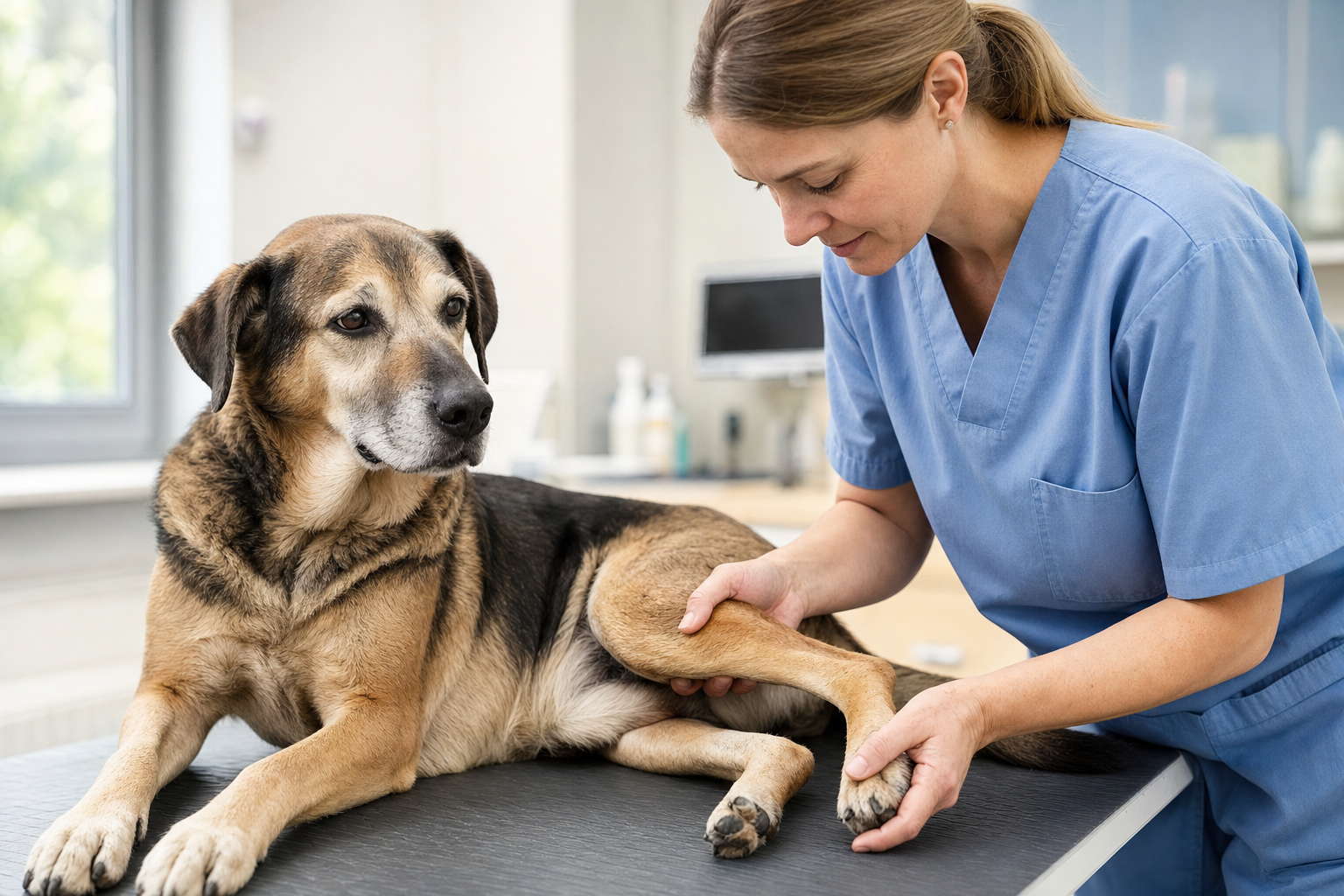
If a dog’s back legs suddenly look wobbly, weak, or uncoordinated, the most important question to answer first isn’t “what disease is this” — it’s “how fast did this happen, and is it getting worse right now.” Sudden, rapidly worsening hind-leg weakness is often an emergency. Gradual weakness that’s been building over weeks or months usually is not an emergency tonight, but it still deserves a veterinary visit soon.
This kind of hind-leg wobbliness has a medical name: ataxia, which simply means uncoordinated movement caused by a problem somewhere in the nervous system — the brain, spinal cord, or the nerves running out to the legs. It’s a symptom, not a diagnosis, and it can come from a surprisingly wide range of causes, from a slipped disc to tick exposure to old-age degenerative disease.
What Owners Usually Notice First
Hind-leg ataxia and weakness can look different from dog to dog, but the most commonly reported signs include:
- Wobbling or swaying in the back half of the body
- Legs “giving out” or slipping sideways, especially on smooth floors
- Dragging or scuffing the tops of the rear paws
- Knuckling — walking on the top of the paw instead of the pad
- Crossing the back legs while walking
- Difficulty rising from a lying position
- Collapsing in the hindquarters after a few steps
- Reluctance to jump, climb stairs, or get into the car
None of these signs point to just one condition. That’s exactly why figuring out how quickly it started matters so much.
Sudden vs. Gradual: The Fastest Way to Sort This Out
Two dogs can have nearly identical-looking wobbly back legs and be dealing with completely different levels of urgency. Onset speed is the best first clue.
Sudden onset (minutes to a day) points toward:
- Intervertebral disc disease (IVDD) — a disc rupturing or bulging and pressing on the spinal cord
- Fibrocartilaginous embolism (FCE) — a small piece of disc material blocking blood flow to part of the spinal cord
- Tick paralysis — a toxin from an attached tick affecting nerve function
- Toxin exposure — marijuana, certain medications, or other ingested substances
- Trauma — being hit by a car, a fall, or another injury
- Snakebite
Gradual onset (weeks to months) points more toward:
- Degenerative myelopathy — a slow, progressive breakdown of the spinal cord seen mostly in older, medium-to-large dogs
- Lumbosacral stenosis — narrowing of the lower spinal canal that puts pressure on nerves
- Chronic, worsening intervertebral disc disease
- Arthritis or hip dysplasia mimicking neurological weakness (this is genuinely an orthopedic problem, not a nerve problem, but it can look similar from across the room)
- Some tumors of the spinal cord
Sudden-onset weakness is far more likely to need same-day or emergency veterinary attention. Gradual weakness usually allows time to schedule a regular veterinary exam — but “usually” doesn’t mean “always,” which is why the checklist below matters regardless of how the weakness started.
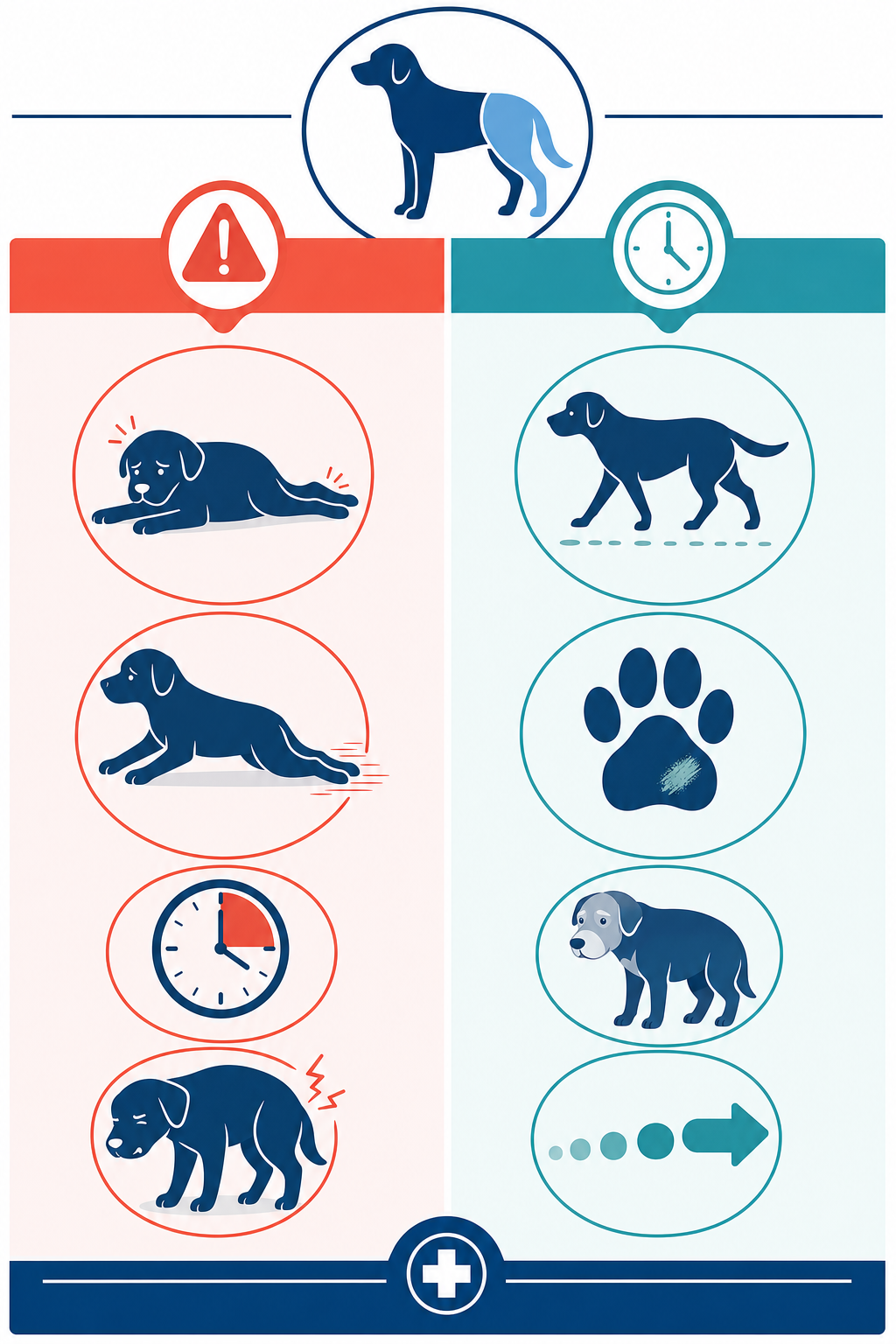
When to Call Your Veterinarian
Go to an emergency veterinary hospital right now if the dog:
- Cannot stand or walk at all
- Is dragging both back legs and cannot reposition them
- Lost bladder or bowel control along with the weakness
- Is crying out, seems painful, or won’t let anyone touch the back or hindquarters
- Has a known or suspected tick bite along with weakness or a change in bark/voice
- Was recently hit by a car, fell, or had another obvious injury
- Has known or suspected access to marijuana, a toxic plant, or medication
- Is getting worse by the hour
- Is having trouble breathing along with the weakness
Schedule a veterinary exam within a day or two (not a true emergency, but don’t wait weeks) if the dog:
- Has mild, stable wobbliness that isn’t getting worse
- Is an older dog with slowly progressing hind-leg weakness over weeks to months
- Scuffs or drags a back paw occasionally, especially after exercise
- Seems otherwise bright, eating normally, and not in obvious pain
This box is deliberately blunt: when in doubt, the safer choice is always to call a veterinarian or emergency animal hospital and describe exactly what’s being seen. Veterinary staff would much rather field a call about a dog that turns out to be fine than see a dog after a treatable spinal problem has progressed to permanent damage.
What Causes Hind-Leg Weakness and Ataxia in Dogs
Intervertebral Disc Disease (IVDD)
IVDD happens when the cushioning discs between the spinal bones bulge or rupture and press on the spinal cord. It’s one of the most common causes of sudden back-leg weakness or paralysis in dogs, and it’s especially common in breeds with long backs and short legs, like Dachshunds, Corgis, and Basset Hounds, though any dog can be affected. About 65% of IVDD problems occur in the mid-to-lower back, and about 18% occur in the neck alone, with the rest involving both regions. Signs range from mild back pain and wobbliness to complete inability to use the back legs. Severity depends heavily on how quickly the problem is caught — if surgery is recommended, delaying it increases the risk that the spinal cord will be damaged beyond recovery.
Degenerative Myelopathy (DM)
Degenerative myelopathy is a slow, painless breakdown of the spinal cord that usually shows up in dogs between roughly 8 and 14 years old. It typically starts as a loss of coordination in the back legs and worsens gradually over six months to a year, eventually progressing to hind-limb paralysis and sometimes affecting bladder/bowel control and the front legs if it continues long enough. German Shepherds, Boxers, Corgis (Pembroke Welsh and Cardigan), Rhodesian Ridgebacks, and Chesapeake Bay Retrievers are among the breeds with a known genetic risk factor, and a genetic test is available, though testing positive doesn’t guarantee a dog will develop clinical disease. Because DM looks similar to arthritis, IVDD, and other spinal problems early on, it’s a diagnosis of ruling out other causes — it should never be assumed just because a dog is older and slowing down.
Fibrocartilaginous Embolism (FCE)
FCE happens when a small fragment of disc material breaks off and blocks blood flow to part of the spinal cord — essentially a spinal cord “stroke.” It causes a sudden, usually painless loss of coordination or leg function, often during running, jumping, or other activity, and mostly affects large and giant-breed dogs, though Miniature Schnauzers and Shetland Sheepdogs may also be predisposed. Unlike IVDD, FCE deficits typically stop worsening within about 12 hours of onset. Many mildly affected dogs improve substantially within one to two weeks, but the outlook is poor if deep pain sensation is lost in the affected legs.
Tick Paralysis
Tick paralysis is caused by a toxin in the saliva of certain feeding ticks that interferes with nerve signaling. In North America, it’s most often linked to the Rocky Mountain wood tick and the American dog tick. Signs usually begin roughly 5 to 9 days after a tick attaches and then progress over the next one to three days, starting with hind-limb weakness or incoordination and a change in bark or voice, and potentially advancing to whole-body paralysis and breathing difficulty if the tick isn’t found and removed. The encouraging news: most dogs improve within 24 to 72 hours once the tick is removed. This is exactly why a thorough, hands-on tick check — including the ears, between the toes, and around the tail — is part of the workup for any dog with new hind-leg weakness.
Toxin Exposure
Several common household substances can cause sudden wobbliness or weakness, including marijuana products, certain over-the-counter and prescription medications, xylitol, and some rodenticides and antifreeze. Ataxia from toxin ingestion often comes with other signs, such as drooling, vomiting, disorientation, dilated pupils, or changes in heart rate, depending on the substance. Any known or suspected ingestion should be treated as an emergency and reported to a veterinarian or animal poison control immediately — trying to “wait and see” wastes valuable treatment time.
Other Causes Worth Knowing About
- Lumbosacral stenosis — narrowing of the lower spinal canal that gradually compresses nerves running to the back legs and tail, more common in middle-aged to older large dogs.
- Vestibular disease — problems in the inner ear or brainstem that cause a wobbly, off-balance gait, often with a head tilt or unusual eye movements; this affects balance more than leg strength itself.
- Arthritis and hip dysplasia — genuinely orthopedic, not neurological, but painful, stiff joints can make a dog’s back end look weak or wobbly, especially getting up from rest or navigating stairs.
- Spinal trauma — from being hit by a car, a fall, or another injury.
- Discospondylitis — a bacterial or fungal infection of the spinal disc space, more common in large, young-to-middle-aged dogs.
- Congenital and inherited disorders — including hereditary ataxia in certain terrier breeds and cervical spondylomyelopathy (“wobbler syndrome”), most often seen in large and giant breeds.
How Hind-Leg Weakness Is Diagnosed
A veterinarian works through this systematically rather than guessing:
- History and observation — when the weakness started, whether it’s getting worse, any possible trauma or toxin exposure, and a description (or video) of how the dog is moving.
- Physical and neurological exam — checking reflexes, paw-placement/knuckling responses, pain response along the spine, and whether the weakness affects one leg, both back legs, or all four.
- Basic bloodwork — to rule out metabolic or systemic causes and check overall organ function before any sedation is needed for imaging.
- Imaging — X-rays can screen for obvious fractures, tumors, or disc space changes; MRI or CT scans give a much more detailed look at the spinal cord itself and are typically needed to diagnose IVDD severity, FCE, or spinal tumors with confidence.
- Specialized testing — spinal fluid analysis or genetic testing (for degenerative myelopathy risk) when the diagnosis is still unclear after imaging.
A short video clip of the dog walking, taken on a phone before the appointment, is genuinely useful — gait abnormalities are sometimes subtler in an exam room than they are at home, and a video preserves exactly what the weakness looks like in real time.
Treatment Options
Treatment depends entirely on the cause:
| Cause | Typical treatment approach |
|---|---|
| IVDD (mild) | Strict rest, anti-inflammatory or pain medication, muscle relaxants |
| IVDD (severe/non-ambulatory) | Surgery to relieve spinal cord pressure; earlier surgery generally gives a better chance of recovery |
| Degenerative myelopathy | No cure; physical therapy and mobility support can slow progression of signs and maintain quality of life |
| Fibrocartilaginous embolism | Supportive care and rehabilitation; many dogs improve on their own over 1–2 weeks |
| Tick paralysis | Tick removal, supportive care, and monitoring; improvement is often rapid once the tick is gone |
| Toxin exposure | Depends on the toxin — may include inducing vomiting (only under veterinary guidance), activated charcoal, IV fluids, or specific antidotes |
| Arthritis/hip dysplasia | Weight management, joint supplements, pain control, and physical therapy |
Rehabilitation — including underwater treadmill work, targeted exercises, and assistive gear like rear-support harnesses — plays a supporting role in recovery for several of these conditions, not just degenerative myelopathy.
What Recovery Looks Like
Recovery varies enormously by cause. A dog with tick paralysis can be back to normal within days of tick removal. A dog recovering from IVDD surgery may need months of restricted activity and rehabilitation. A dog with degenerative myelopathy won’t recover lost function, but supportive care can meaningfully extend comfortable, mobile time. This is exactly why getting an accurate diagnosis matters more than guessing based on age or breed alone — the right diagnosis changes both the treatment plan and what to realistically expect.
Frequently Asked Questions
Is a dog’s wobbly back legs always an emergency?
Not always, but sudden or rapidly worsening weakness should be treated as one until a veterinarian says otherwise. Gradual weakness that’s stable and not associated with pain, incontinence, or trouble breathing can usually wait for a scheduled exam within a day or two.
Can a dog recover from ataxia?
Many dogs do recover, especially from tick paralysis, mild IVDD, and fibrocartilaginous embolism. Recovery from degenerative myelopathy isn’t possible since it’s a progressive disease, though supportive care helps. The specific cause determines the outlook far more than the symptom itself does.
What’s the difference between degenerative myelopathy and IVDD?
Degenerative myelopathy comes on gradually over months and isn’t painful. IVDD often comes on suddenly (though it can also be gradual) and is frequently associated with back pain, especially early on. Imaging is usually needed to tell them apart with confidence, since both can cause similar-looking hind-leg weakness.
Should I let my dog keep walking if the back legs seem weak?
Light, supervised movement is fine for mild, stable weakness, but if a spinal injury or IVDD is possible, minimizing jumping, running, and stair use until a veterinarian has been consulted is safer. A dog that suddenly can’t bear weight on the back legs should be kept as still as possible and taken in promptly.
Can arthritis look like a neurological problem?
Yes. Painful, stiff joints from arthritis or hip dysplasia can make a dog’s back end look wobbly or weak, especially when rising or on stairs, even though the nervous system itself is normal. A veterinary exam is the only reliable way to tell the difference.
Are certain breeds more likely to develop these conditions?
Yes. Dachshunds and other long-backed breeds are prone to IVDD. German Shepherds, Corgis, Boxers, and a number of other breeds carry a known genetic risk factor for degenerative myelopathy. Large and giant breeds are more often affected by fibrocartilaginous embolism. Breed tendencies are useful context, but they don’t replace a diagnosis.
Does hind-leg weakness always affect both legs equally?
No. Some conditions, like FCE or a lateralized disc problem, can affect one side more than the other. Symmetrical weakness in both back legs is more typical of degenerative myelopathy, lumbosacral stenosis, and many toxin exposures.
What should I do right now if I think a tick caused this?
Do a thorough, hands-on check of the whole body, including the ears, between the toes, around the tail, and the mouth and gum line. If a tick is found, remove it carefully and call a veterinarian, since a full veterinary exam is still important even after removal. If no tick is found but the signs match, veterinary evaluation is still warranted.
Related Reading
- My dog is limping — for gait changes that look more orthopedic than neurological.
- My dog is paralyzed — for the most severe end of the hind-leg-weakness spectrum.
- Patellar luxation in dogs — an orthopedic condition that can contribute to hind-leg gait changes.
- Dog is in pain — for help assessing whether pain is part of the picture.
- Dog crying pain — recognizing pain-related vocalizing and behavior.
- What kills puppies — relevant for rare congenital causes of ataxia in young puppies.
- Signs that a dog is dying — context for advanced degenerative myelopathy quality-of-life decisions.
- Bufo toad poisoning in dogs — a Florida-relevant toxin cause of sudden neurological signs.
- Addison’s disease in dogs — a metabolic cause of weakness that can resemble neurological ataxia.
- Cushing’s disease in dogs — an endocrine condition associated with muscle weakness in senior dogs.
Veterinary Sources & References
- Merck Veterinary Manual — Congenital and Inherited Spinal Cord Disorders in Dogs and Cats
- Merck Veterinary Manual — Tick Paralysis in Animals
- Merck Veterinary Manual — Vascular Diseases of the Spinal Cord in Animals
- Cornell University College of Veterinary Medicine, Riney Canine Health Center — Intervertebral Disc Disease
- Orthopedic Foundation for Animals (OFA) — Degenerative Myelopathy
Leave a Reply